

Worship Times Christian Education Pastor Church Leaders
J.O.Y. Multimedia Links Contacts

AN HISTORICAL SKETCH

When the first settlers came to the Town of Richmond, they came to a wilderness. There was no church or school. Transportation was by oxen, horses, or on foot. A traveling minister came around occasionally to baptize children, perform weddings, and bury the dead. The early settlers began to gather weekly in their homes to worship. A pastor from St James, Shawano, began to come every two weeks to lead the worship. Worship on the alternate Sunday was led by one of the laymen.

Many settlers had come up along the Wolf River and stopped in the area of Belle Plaine. That region was settled earliest and consequently the Lutheran church there was the first in this area. The Town of Richmond children, in the early days, went to Belle Plaine to be confirmed. They boarded with farmers in that area during confirmation instructions. Pastor Hudtloff confirmed many of them.

The record of the baptism of the first area child was that of (Auguste) Emilie Buettner, sister of Albert Buettner, born August 14, 1870, and baptized November 8, 1870. The first recorded marriage was that of Wilhelm Kosban and Wilhelmine Samp on October 21, 1875.

In 1863 twelve families got together to build a church. Land was bought from Wm. Wendorff and August Engel on November 24, 1883 for a consideration of $25.00. William Barfknecht gave permission to go in his forest to cut logs for the church. Each of the twelve members was assigned to cut a certain number of logs. The log church was built in 1885 on a site just east of the present parsonage. The altar, pulpit, and benches were built by William Barfknecht. The size of the church was about 28’ x 32’. It was built for a total cost of $100, land included!

A cast iron box heater stood at the north end of the room with the stove pipe extending to the chimney at the south end. This long stove pipe helped to heat the interior. When evening services were held, each family brought its own candle with holder or kerosene lantern to help light the church.

The first baby baptized in the log church was Martha Marie Elizabeth Buettner, another sister of Albert Buettner, born September 6, 1885, and baptized September 13, 1885. After the log church was built, Pastors probably came regularly, but services were held Sunday afternoons because the pastor held services at St. James, Shawano, in the forenoon and travel by horses was slow.

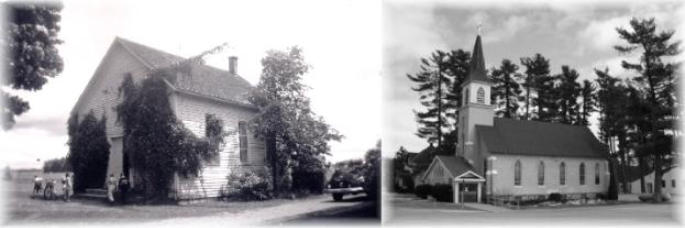
The log church was later sided and painted. It served as the house of worship until 1908, and as the school and meeting hall until November, 1951, when the present parish hall was completed. The old pulpit later graced the pine grove and was used during the mission festival outdoor services for many years.

Mission festivals were held since the early days. Each one was a big event in the church year. Outdoor services were always held and, of course, the cooking and eating was also done outdoors. Margaret Martzke remembers her mother cooking coffee in a big iron pot on the church grounds. Homemade ice cream was made with several young men and boys taking turns cranking the ice cream freezer until it was done. For this they received their dish of ice cream free. An outside speaker was invited to deliver the sermon. Proceeds from the ice cream and other items which were sold that day would go to missions.

In 1907 and 1908 the present church was built under the guidance of Pastor F.F. Selle. The architect was Christ Fritze and the principal carpenter was Henry Krueger. The bricklayer was Albert Dickow from Gresham. Albert Buettner and Herman Nuske, as members of the church board, laid the cornerstone for the new church. Albert Buettner was also one of the principal builders of the church, using his skills in masonry to good advantage. The new church cost $4,425.48. The 600-lb. bell was pulled up to the steeple by Albert Wendorff and his team of horses, using a hayfork rope. Albert Buettner and Ernest Engel bravely climbed into the steeple and guided the bell into place. The bell cost $90 with $14 for freight. The furnace cost $100.

Lighting was done using beautiful “crown lights.” These were circles of 8 or 10 kerosene lamps with decorated chimneys hanging from the ceiling that could be lowered for lighting or extinguishing. There were also kerosene lamps in racks along the sides.

By 1909 the membership had grown to 34 families. The Shawano pastors continued to serve St. James, Town of Richmond, until 1914. Pastor Selle encouraged the building of the parsonage and the calling of a separate pastor, as it was becoming more than they could handle.

Sunday School was held for the children of the congregation by the Shawano pastors in the early days, but was replaced by a 2-month term of summer school in the early 1900’s. School was held full days from 9:00 to 4:00. It was taught by students from the church colleges. Language, reading, Bible history, and Catechism were taught, but arithmetic was not included. Books used were published by Concordia Publishing House.

The German language was used exclusively at first, both in the worship services and in summer school. It wasn’t until the 1930’s that an effort was made to switch to English. In 1935 the minutes of the voter’s assembly were first written in English.

Confirmation instructions were given at St. James, Shawano, until 1914. These classes were held 3 and sometimes 4 half days a week for one winter. Many of the young people walked to “instructions.” As school consumed the forenoon and walking home used up much of the afternoon on 3 or 4 days a week, it became difficult to continue to attend public school during eighth grade. Many children, therefore, dropped out of public school before or during their last year. Confirmation instructions were also given in German. Public school, however, was conducted in the English language.

Families who lived within a mile or two of church walked to worship services long ago. Often a group of them would gather and walk through the woods and across the fields together. For those families who lived farther from church, horses were their means of transportation. A row of horse sheds was built to protect these animals during services. Each family constructed its own shed and later removed it when horses were no longer used. These sheds were located about where the parish hall is now.

The Ladies Aid was organized in 1923 under the guidance of Pastor Stuth. This organization has been a faithful and active arm of the church throughout its 50-year history. The ladies did innumerable small and large duties to further the Lord’s work. They cooked meals, cleaned church buildings, worked for the cause of home and foreign missions and quietly accomplished what the church body sometimes had difficulty with. One of its projects was the purchase of all the colored altar cloths, except the black one we now use only on Good Friday.

The black cloth was the first one to be purchased for the church. It was green when bought by the congregation and it was used at all times. (Later, it was dyed black). A special meeting was called to decide which one to buy and the price of $5.00 was termed “outrageous”.

In 1924 the Richmond Church Band was formed. Ed Lindner and Bill Kroenke went around to the homes of the members of the congregation and asked the young men to join. Bill Koehler became the first director. His father, Gust Koehler, helped instruct the young men in the use of their instruments and also played with the band for some time. Bill’s younger brother, Herman, also helped. Later, in 1928, Herman Koehler became the director until he went off to the University. Then Bill Kroenke became the final director.

The young men were given instruction books to use at home and they met once a week to practice at the old school house “until the windows rattled!” Albert Wendorff’s cows were shocked at the sounds coming from the once peaceful old school house! Eventually, though, the sounds became quite musical and the band was invited to play at many functions throughout each summer. It played at many church mission festivals, “Declaration Day” services, fairs, church school picnics, parades, and other festivities. They were paid well for their services and in 1928 they bought uniforms for $17 each. They had already bought caps in 1926. The caps and uniforms were navy blue with gold trim.

By 1929 the old gas lantern didn’t seem sufficient anymore and the band members decided to “wire the old school house.” It was done for $5 by Emil Krueger. The gas lantern was sold to Frank Opperman along with a pint measure and the gas can, for $1.50.

In 1930 the band took on a new look with white shirts, white duck trousers and cap covers.

The members of the band held an annual meeting and any special meetings that seemed necessary. They elected officers and laid down rules under which to govern themselves. Ed Lindner was elected first president of the organization and he was re-elected again and again so that he was the president for the entire life of the band. Bill Kroenke held the office of secretary until he asked to be relieved in 1940. The band continued until 1942.

The Young People’s Society has been active in the work of the church for many years too. In 1936 the society was thanked by the church body for donating the beautiful collection plates. They were wooden with a velvet lining in the bottom. Before that, the offering was taken in a black velvet sack with a gold tassel, which was at the end of a long pole.

The envelope system for offerings was begun in 1928.

Some things were simpler long ago. The voter’s assembly adopted a budget of $1,500 in 1936. The entire budget follows:

Salary $1,200 Lights 24 Organists 40 Telephone 15 Janitor 50 Wood 100 $1,429

In 1938, it was decided to redecorate the church for a cost of $800 or less, excluding pictures. Sunday offerings had been saved for this purpose since January 1, 1937.

Voter’s meetings were held after Sunday services and often were continued for 2 or 3 weeks if all business could not be transacted in one session.

In 1936, one dozen English Hymn books were purchased. In 1939, German services were held in the morning and English services were conducted in the afternoon. Later in 1939, it was decided to hold both worship services in the forenoon. German services were gradually dropped. In 1944, services were held in German every other Sunday. The services on alternated Sundays were in English. Later, there was one German service per month. The German services were discontinued entirely in 1958.

In 1941, the curbs on the graves were removed, the cemetery was leveled, and a lawn mower was bought. Modern times were coming, and the following year the woodshed was sold and moved.

By this time, the education of the children was carried on in half-day Saturday School classes throughout the public school year and 6 weeks of half-day Summer School. Secular instruction had long since been dropped and the half day was devoted entirely to religious instruction.

On April 12, 1942, a motion was made and carried in the voter’s assembly to join the “Synod.”

A new organ was also bought in 1942. The choir was perhaps the largest in the 1940’s, having as many as 28 members. It was active in this church as well as singing for other church gatherings and even cutting a record!

The country was engaged in World War II from 1941 until 1945. Many young men from this congregation went off to war, and some did not return. These men were remembered in countless prayers and in the weekly church bulletins. A motion was made and carried in the voter’s assembly of October 7, 1944, which reads thus, “If peace is declared in Europe before 12 o’clock noon, there will be services that same evening at 8 o’clock. If it is declared after 12 noon, services shall be the next evening at 8 o’clock. (VE Day finally came May 8, 1945.)

It had been the custom, since the early days, for the men of the congregation to sit on the left side of church during worship services and the women to sit on the right. The men also went to communion first. In 1945, the voter’s assembly decided to have “mixed communion” thereafter.

In 1946, it was decided to place the Lutheran Witness in every home of the congregation “permanently.” It was also decided to send a delegate to the synodical convention. In 1947, the voters entered in the record that the Centennial Service would be held on April 27th in English. In 1948, St. James, Town of Richmond, joined the Radio Church of the Air.

In 1949, the church fathers discovered that our church records were not up to date. Much information was recorded in Shawano and elsewhere. A motion was made to have a complete record made of the congregation by card system. (Incidentally, these writers have found that perhaps this motion was not carried to fulfillment!)

The records show much work carried on in the local congregation pertaining to upkeep of the church buildings and grounds. The trustees were busy with furnaces that refused to do as the manufacturers promised, roofs that leaked periodically, trees to be removed, trimmed or planted, painting to do and many other repairs. After the Men’s Club was organized, many of these jobs were relayed to them. Many of the men of the Men’s Club possess skills in carpentry, mechanics or electrical wiring. These have all come in handy through the years.

The local congregation has also reached out to help spread the gospel to others in the area and throughout the world. Many donations were given to various mission causes during the last thirty years. Clothing has been sent to Lutheran World Relief since the 1940’s. In 1952, it was decided to sponsor the importation of Displaced Persons from Europe. The regular mission budget was continually increased as it was deemed necessary.

The Ladies Aid and LWML have also been active in the mission field.

Twice monthly family Bible study was instituted in 1950.

In 1951, it was decided to build a parish hall. The cost was not to exceed $20,000. The wage scale was $.75 an hour. The men of the congregation were to donate 30 hours of free labor. Members of the building committee were Art Kriewaldt, Bob Kroenke, Carl Teetzen, Hubert Martzke, and Franklin Krueger. Hubert Martzke was chairman of the building committee and Bob Kroenke was head carpenter. The Men’s Club bought sporting equipment for the parish hall and helped in many other ways. A dedication service for the new parish hall was held in the late fall of 1951.

As there was a pastor shortage, St. James Town of Richmond merged with St. John, Town of Herman in 1956. Both churches were then served by the one pastor. Many adjustments had to be made on the part of both congregations and the pastor, but this merger worked well for many years.

In 1965, Bob and Lois Kroenke left for 5 years of work in the New Guinea mission fields. Through their letters, pictures and talks we came to be aware of foreign missions as we had never been before. Their work has been an inspiration to all our members. We thank our Lord for aiding and protecting them while there, and bringing them safely back to our midst.

In 1966, Chas and Eilene Buettner donated a beautiful new organ to the church in memory of their sainted daughter, LuAnn.

In 1968, the Men’s Club purchased and put up playground equipment.

In 1971, Pastor Gaertner helped with the organization of the Altar Guild. The members of the Altar Guild place flowers on the altar, change altar cloths, buy candles and baptismal napkins, make banners, and keep the altar and its furnishings clean and polished.
1n 1976, on May 2nd, Pastor Allen was installed at St. John, Hermansfort, and St. James, Town of Richmond.  He served from 1976-1977.

In 1977, the name of the church was changed from St. James to St. Jakobi, which is the German form of the same name.  This was done to avoid confusion with St. James Lutheran Church, Shawano.  There were major repairs and minor additions to the buildings.

In 1978, on August 27th, Reverend Kenneth Martin was installed at St. John, Hermansfort, and St. Jakobi, Town of Richmond.  New lights were installed in the church and Monday evening services were added.

1n 1981, on November 1st, Rev. Martin was instrumental in the opening of the LCFS (Lutheran Counseling and Family Services) Thrift Store in Shawano.  Many of our ladies have worked there. 

In 1984, on January 8th, Pastor Kenneth Thiele was installed at St. Jakobi.

In 1985, the St. Jakobi Library Association was organized.  The purpose of the Library Association is to bring people to Jesus Christ and to enable Christians to increase their faith and knowledge of Jesus.  Also St. Jakobi became a single parish with Rev. Thiele as our Pastor.

In 1987, on July 5th, Pastor David Johnson was installed at St. Jakobi.  And the church constitution was changed – “All members 18 years and over are automatically voting members without signing the constitution.”

In 1988, St. Jakobi began having Saturday evening services.  August marked the Mission Festival and the new narthex was dedicated.

In 1990, on October 14th, Reverend Doug Fleischfresser was installed at St. Jakobi. 

In 1991, Pastor Fleischfresser was accepted into the Chaplaincy Program. 

In 1995, on March 19th, Pastor Timothy Lamkin was installed at St. Jakobi. 

In 1998, on June 14th, the St. Jakobi Park was dedicated in memory of Jim Selle.  Tim Lamkin, Jr. designed the playground equipment as an Eagle Scout project.

In 2006, in April, we celebrated with a groundbreaking ceremony for a new church to be built south of the current Parish Hall.  On Reformation Day, in October, the new church was dedicated.

In 2007, beginning in September, Pastor John Laatsch, from Faith United, Gillett, served as our vacancy pastor, and continued to serve us until June 22, 2008. 

In 2008, June 22nd, Pastor Travis Kleinschmidt was installed as the 19th pastor of St. Jakobi, which was founded in 1883.

Family nights have served an important function during the past two decades. Various organizations of the church have sponsored them for a variety of reasons. Some sponsored by the choir some years ago were almost entirely for entertainment and fellowship. Others have been for educating the members of the congregation about mission work or other work of Synod and our local congregation.

On looking back, we can truly say with the hymn writer:

The Lord hath helped me hitherto By His surpassing favor; His mercies every morn were new, His kindness did not waver.

And now, let us look to the future and continue to pray:

Help me henceforth, O God of grace, Help me on each occasion, Help me in each and every place, Help me through Jesus’ passion. Amen

PASTORS OF ST. JAMES, TOWN OF RICHMOND

PASTOR P.H. DICKIE – 1863-1879 He was a pioneer missionary and founder of 24 congregations in this vicinity. He went to St. James, Shawano, from Belle Plaine. He served the Lutherans in the area around Shawano as a “raise predeger” (traveling pastor). Services were held in the homes at infrequent intervals. Pastor Dickie went to the Town of Washington in 1879.

PASTOR C.F. EBERT – 1879-1888

PASTOR THEO. NICKEL – 1888-1901 He was the first pastor to serve, both, St. James, Shawano, and St. James, Town of Richmond. He brought the first small organ to this church.

PASTOR E HANOW – 1901-1906 He came to St. James, Shawano, from a pastorate in Australia.

PASTOR F.F. SELLE – 1906-1914 He was a energetic pastor who oversaw the building of our new brick church. He donated the altar statue. By 1914, he felt unable to adequately serve the two parishes so he asked Town of Richmond to call a separate pastor. He was a great fisher of men and also of trout. He moved into the new parsonage and, two years later, he brought his bride there. Their first four children were born here. He organized the Ladies Aid in 1923.

PASTOR WALTER C BAUMANN – 1926-1941 Pastor Baumann came to our congregation from MacNutt, Sask, Canada. The interior of the church was redecorated while he was here. He was a great teacher of children, using visual aids a great deal in the summer and Saturday schools.

PASTOR MARTIN A SCHNEIDER – 1942-1948 A jolly, outgoing person, Pastor Schneider encouraged the church organizations in Christian service and fellowship. He organized the Men’s Club while he was here. He and his wife shared teaching duties for an ever-increasing number of youngsters in the Saturday and summer school classes.

PASTOR ARTHUR SCHEDLER – 1949-1955 Another ardent fisherman and hunter, Pastor Schedler came to Town of Richmond in June of 1949. He delighted many of the older members with his fluent German. The parish hall was built while he was here. He encouraged the young people to take an active part in the work of the church.

PASTOR H.H. WEGNER – 1956-1960 He became our pastor after we merged with St. John’s, Town of Herman. He and his wife enjoyed music, and he encouraged the choir to be active in the church and in radio broadcasts.

PASTOR L.I. GOING – 1960-1970 Pastor Going was also a fisher of men and of trout. He and his wife encouraged missionary work and support. Their son was a missionary to Japan (Pastor Thomas Going). While Pastor Louis Going was here, the parsonage was remodeled and the garage was built.

PASTOR MARK GAERTNER – 1971-1975 For the first time in 57 years, St. James welcomed a young pastor in July of 1971. Pastor Gaertner has encouraged the members to be Christian missionaries wherever they are. He has shown his concern for each individual member and his problems.

PASTOR WILLIAM ALLEN – 1976-1977 – Pastor Allen came to St. Jakobi from Trinity Lutheran, Egypt Mills, Missouri. 

PASTOR KEN MARTIN – 1978-1983 – Pastor Martin came from St. Stephen Lutheran Church, Watertown, and was very active in other activities besides his ministerial duties.  He served as Zone Counselor of the Walther League, Lutheran Laymen’s League, Lutheran Women’s Missionary League, and also various circuit committees.  He was instrumental in starting the LCFS Thrift Store in Shawano. 

PASTOR KENNETH THEILE – 1984-1987 – Pastor Theile came to St. Jakobi from a parish in Iowa.  Prior to being in Iowa, they were missionaries in New Guinea.  Pastor Theile enjoyed playing tennis. 

PASTOR DAVID JOHNSON – 1987-1990 – Pastor Johnson did his vicarage at St. John Lutheran Church, Defiance, Ohio.  He graduated from seminary with a Master of Divinity degree in May of 1987.  He had an interest in old cars.  He was self-employed several summers doing body work and painting cars. 

PASTOR DOUGLAS FLEISCHFRESSER – 1990-1994 – Pastor Fleischfresser served his first congregation at Grace Lutheran in Winchester, Kentucky.  Pastor Fleischfresser enjoyed many sports, horseback riding, deer hunting, woodworking, chess, computer hacking, and good conversation.  He served his country by entering the Chaplaincy Program. 

PASTOR TIMOTHY LAMKIN, SR. – 1995-2007 – Pastor Lamkin spent one year serving Immanuel Mohican Lutheran Church, Gresham, WI, as their Vicar before returning to Fort Wayne to finish his seminary training.  Pastor Lamkin loved to fish, especially ice fish.  He particularly enjoyed watching his boys’ ball games and other outdoor activities.  He was also very active in the Boy Scouts.

PASTOR TRAVIS KLEINSCHMIDT – 2008-Current – Pastor Kleinschmidt is originally from Illinois and St. Jakobi is his first church after graduating from Concordia Theological Seminary, Fort Wayne, IN.  He served his vicarage in Gresham, OR, at Redeemer Lutheran Church.  He enjoys playing basketball and spending time with his family. 

THE TWELVE ORIGINAL FAMILIES OF ST. JAMES, TOWN OF RICHMOND

Wm. Barfknecht, August Buettner, Carl Buettner, August Engel, Sr., August Gueths, Wm. Kosbab, Henry Lindner, Albert Teetzen

Albert Tiegs, John Timm, Wm. Wendorff, Fred Yordi

ORGANISTS OF ST. JAMES, TOWN OF RICHMOND

Mary Engel, Margaret Moede, Linda Erdmann, Ruth Baumann, Florence Erdmann, Leona Daebler, Lynda Lindner, Mrs. M.A. Schneider, Esther Lindner, Charles Buettner, Minnie Spohn, Leona Daebler, Sheri Fleischfresser, Vicki Buettner, Laurel Marquardt, Wendy Kuepper, Helen Exner, Mary Jung, Elmer Ackerman, Roz Westphal, Joanne Bublitz, Emily Teetzen

A Note on the Authors of This Historical Sketch:

A group of about six women of the church spent many afternoons and evenings one summer going through the church records, other documents, and their own memories to produce this sketch. The women were in their 70’s and 80’s at the time and their memories went back to the turn of the century. Their scribe, composer and avid listener was Shirley (Martzke) Krueger.

The women included: Mrs. John (Eva) Kriewaldt Mrs. Hubert (Margaret) Martzke Mrs. Henry (Margaret) Kroenke Mrs. Charles (Elsie) Teetzen Mrs. Charles (Alma) Engel Albert Buettner was also interviewed at length.

THE RICHMOND BAND 1924-1942

Directors: Bill Koehler Herman Koehler Bill Kroenke

Members Instrument Played Franklin Krueger Clarinet Emil Krueger Clarinet Orville Teetzen Snare Drum Henry Teetzen Bass Drum Karl Teetzen Alto Bill Kroenke Coronet Paul Krueger Alto Benjamin Steinberg Coronet Hubert Lindner Coronet Ed Lindner Baritone Leonard Krueger Bass Rudy Kroenke Sousaphone Frank Opperman Trombone Walter Kroenke Trombone Emil Gueths Snare Drum Rob Utke Coronet John Montour Coronet Frank Engel Bass Drum John Kroenke Bass Art Kroenke Coronet Herman Koehler Coronet Gust Koehler Clarinet


125 YEAR STATISTICS

During these 125 years there have been 923 baptisms, 592 confirmed, 249 marriages, and 302 burials.  Under the Blessings of God the congregation has grown to the present size of 495 baptized members.

ST JAKOBI BUILDING COMMITTEE NEW CHURCH PROJECT 2006

Committee Members:
Art Bahr, Pastor Tim Lamkin, Brad Teetzen, Barb Bahr, Dale Magee, Marlyn & Kathy Teetzen, Dave Hoffman, Fred Opperman, Donna Ward, Art Kriewaldt, Rich Raddant, Chrm., Paul Weismantel, Lois & Bob Kroenke, Darlene Ross, Curt Wendorff, and Dan Krueger.

Laborers for Christ Program

Our congregation chose to use the Laborers for Christ Program, which is a ministry of the Lutheran Church Missouri Synod (LCMS) and the Lutheran Church Extension Fund, made up of dedicated Christian men and women who use a portion of their retirement time to work for the congregations, schools, and social ministries of the Lutheran Church Missouri Synod as these organizations build, expand or improve their facilities.

The laborers are retired “willing workers” whose skills range from years of experience in construction to handymen. They have committed themselves in employment at minimum wage to organizations of the LCMS who desire to construct their facilities. Laborers also join in the spiritual life and ministry of the congregation and set an example of unselfish service by dedicating their “labor of love” to the glory of Jesus Christ.

We felt blessed to have these wonderful people join us in building our church:

Dan & Bev Curd Irving, TX Bob & Flo Natzke Greenleaf, WI Chuck & Shirley Pattillo Pflugerville, TX Marvin & Bernice Perleberg Luxemburg, WI Edwin & Arta Walter Plymouth, MN Elz & Marsha Wilson Pueblo West, CO

The building project cost was originally estimated at around $1.1 million; however, with the help of the Laborers for Christ and many contractors being members of our church, the final cost was $823,037. The congregation has moved many items from the old church to the new one. These include the altar, pulpit, lectern, baptismal font, stained glass windows, light fixtures, banners and other items.

We look forward to Gods blessings on our future as we serve Him from our new house of worship.

“ALL FOR THE GLORY OF GOD ”


W8089 C.T.H. A | Shawano, WI 54166 | P: (715) 524-4347 | info@stjakobi.org